
March 9, 2026
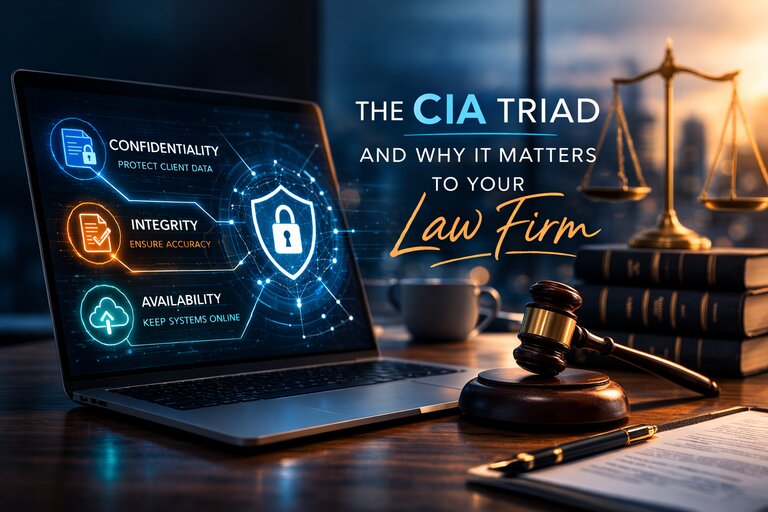
Cybersecurity can feel abstract until it affects a law firm’s ability to serve clients. The North Carolina State Bar is currently warning lawyers about TOAD attacks against trust accounts, where phishing and phone-based social engineering are used to steal credentials and gain online access. NIST, meanwhile, still frames information security around three foundational goals: confidentiality, integrity, and availability. For a Raleigh law firm, that makes the CIA triad a practical way to understand what your security program is supposed to protect every day.
Whether your firm handles litigation, family law, real estate, estate planning, or business matters, the same questions keep coming up. Can you keep client information private? Can you trust that legal documents and records are accurate? Can attorneys and staff access the systems they need when deadlines are tight? The CIA triad answers those questions in plain language, which is exactly why it is such a useful framework for Raleigh law firm cybersecurity.
What Is the CIA Triad?
NIST defines the CIA triad as the three pillars of information security. Confidentiality means preserving authorized restrictions on access and disclosure. Integrity means guarding against improper modification or destruction and ensuring authenticity. Availability means ensuring timely and reliable access to and use of information. NIST also notes that data integrity applies to information in storage, during processing, and while in transit.
That framework matters because it is simple enough for managing partners, office administrators, and attorneys to use without needing a technical background. NIST’s Cybersecurity Framework 2.0 says its guidance can be used by organizations of any size, sector, or maturity level, and it specifically notes that lawyers are among the audiences who can use it to guide cybersecurity-related decisions.
Why the CIA Triad Matters to Law Firms in Raleigh
For North Carolina lawyers, cybersecurity is not just an IT issue. It is tied directly to professional responsibility. Rule 1.6(c) says a lawyer must make reasonable efforts to prevent the inadvertent or unauthorized disclosure of, or unauthorized access to, information relating to the representation of a client. Rule 1.1, Comment [8], adds that lawyers should keep abreast of the benefits and risks associated with technology relevant to their practice.
That is why the CIA triad is so relevant to a Raleigh law firm. It translates cybersecurity from a pile of products into three business outcomes that leadership can understand. Confidentiality protects privileged and sensitive information. Integrity protects the accuracy and trustworthiness of documents, emails, records, and billing data. Availability protects the firm’s ability to work, bill, communicate, and meet deadlines. When you look at cybersecurity through that lens, it becomes much easier to see where your current environment is strong and where it is vulnerable.
Confidentiality: Protecting Client Information and Privilege
For most attorneys, confidentiality is the most familiar part of the CIA triad. It is the principle behind limiting access to client files, protecting email accounts, securing mobile devices, and making sure the wrong person cannot open the wrong matter. North Carolina’s Rule 1.6 comments make clear that reasonable efforts depend on factors such as the sensitivity of the information, the likelihood of disclosure if added safeguards are not used, the cost and difficulty of added safeguards, and whether the safeguard would make representation unreasonably difficult. The same comments also say lawyers must take reasonable precautions to keep communications from unintended recipients, while recognizing that special circumstances may require special precautions.
For a Raleigh law firm, that has real operational consequences. Confidentiality is not just about telling users to be careful. It means controlling access by role, removing access quickly when someone leaves, securing remote access, reducing email risk, and making sure vendors that store or process client information are being managed responsibly. It also means recognizing that not every matter carries the same sensitivity. A routine internal email is not the same as a merger document, a custody file, a settlement strategy memo, or trust-account access. The more sensitive the information, the more important it is that your cybersecurity controls reflect that reality.
North Carolina ethics guidance also shows that confidentiality extends well beyond the four walls of the office. In 2011 Formal Ethics Opinion 6, the State Bar said lawyers may use software as a service if they use reasonable care to safeguard confidential client information. In 2008 Formal Ethics Opinion 5, the Bar said web-based client access can be permissible, but only if the firm ensures each client can access only that client’s own information and that third parties cannot access the file. In other words, cloud tools and client portals are not off-limits, but they must be implemented and managed carefully.
That is an important message for any Raleigh law firm evaluating managed IT services. A good IT and cybersecurity partner should not treat confidentiality as a checkbox. They should help you decide which systems deserve stronger controls, how access should be segmented, how client-facing tools should be secured, and how to reduce the chance that a phishing email or weak account setup turns into a reportable incident.
Integrity: Protecting the Accuracy of Legal Work
Integrity gets less attention than confidentiality, but for law firms it is just as important. NIST defines integrity as guarding against improper modification or destruction of information and ensuring authenticity. In legal work, that shows up everywhere: the correct version of a contract, the accuracy of a docket date, the trustworthiness of billing records, the completeness of a discovery file, and the confidence that a scanned exhibit or signed document has not been altered in an unauthorized way.
North Carolina’s metadata opinion makes the point especially clear. In 2009 Formal Ethics Opinion 1, the State Bar said a lawyer must use reasonable care to prevent disclosure of confidential information hidden in metadata when sending an electronic communication. It also said a lawyer who receives an electronic communication may not search for and use another party’s confidential metadata. That matters because legal documents often carry redlines, comments, history, timestamps, and embedded information that can reveal far more than the visible text on the page.
For a Raleigh law firm, integrity is what keeps “final” actually final. It depends on disciplined document management, version control, audit trails, permission design, secure sharing, and change tracking that makes it clear who edited what and when. It also depends on users having consistent workflows instead of saving sensitive files all over the place with unclear naming and no oversight. If attorneys and staff are regularly asking which copy is current, whether a file was changed, or whether a record can be trusted, that is not just an efficiency problem. It is an integrity problem.
Availability: Keeping the Firm Productive
Availability is often the part of cybersecurity law firms notice first during a crisis. NIST defines availability as ensuring timely and reliable access to and use of information. For a law firm, that means attorneys and staff can get to email, calendars, case files, practice management systems, billing platforms, and shared documents when they need them. Not eventually. Not after a long outage. When the work has to happen.
North Carolina’s 2011 SaaS opinion is highly relevant here too. The opinion says lawyers have duties to protect client property from destruction, degradation, or loss, including loss caused by system failure, natural disaster, or even the dissolution of a vendor’s business. It also says lawyers need to be able to retrieve client data in a usable form outside a vendor’s product. That is a powerful reminder that availability is not just about preventing downtime today. It is about making sure the firm can still function tomorrow if a provider fails, a system breaks, or a cyber incident disrupts operations.
That is why availability is bigger than “we have backups.” Backups only help if they are complete, recoverable, timely, and usable. Availability also depends on monitoring, endpoint management, patching, recovery planning, vendor due diligence, and clear ownership during an incident. If your Raleigh law firm’s IT provider cannot explain how fast systems can be restored, what the recovery priorities are, or how attorneys would keep working during a major outage, then availability is still a weak point in your cybersecurity program.
How the CIA Triad Helps You Evaluate an MSP
One of the biggest advantages of the CIA triad is that it gives law firm leaders better questions to ask. Instead of asking whether you have antivirus or a firewall, ask how confidentiality is protected for privileged data, how integrity is preserved for legal documents and records, and how availability is maintained when systems, users, or vendors fail. Those questions are easier to tie to client service, ethics obligations, and business risk.
NIST’s Cybersecurity Framework 2.0 is designed to help organizations understand, assess, prioritize, and communicate cyber risk regardless of size or maturity. Its small-business quick-start guide even says the framework can serve as a discussion prompt with the outside provider helping reduce your cyber risk, such as a managed security service provider. For a Raleigh law firm, that means the right MSP should be able to turn the CIA triad into a practical roadmap: who should have access, how critical data is protected from improper change, and how the firm will recover when something goes wrong.
Final Thought
For Raleigh law firms, the CIA triad is not academic theory. It is a practical way to think about what your technology environment must do every day: protect client confidentiality, preserve the accuracy of legal work, and keep the firm operating under pressure. North Carolina ethics guidance makes clear that lawyers must use reasonable efforts to protect client information and stay current on the risks and benefits of relevant technology. NIST provides a clear framework for turning those obligations into understandable security outcomes.
If your firm wants to know how it stacks up, start by evaluating your environment through the CIA triad. Where are the confidentiality gaps? How do you verify integrity? How quickly can you recover access to critical systems? Those answers will tell you far more than a generic conversation about “cybersecurity” ever will.
Looking for managed IT and cybersecurity for your Raleigh law firm? We help law firms identify confidentiality gaps, reduce document and email risk, improve recovery readiness, and build a practical security roadmap aligned to the way legal teams actually work.